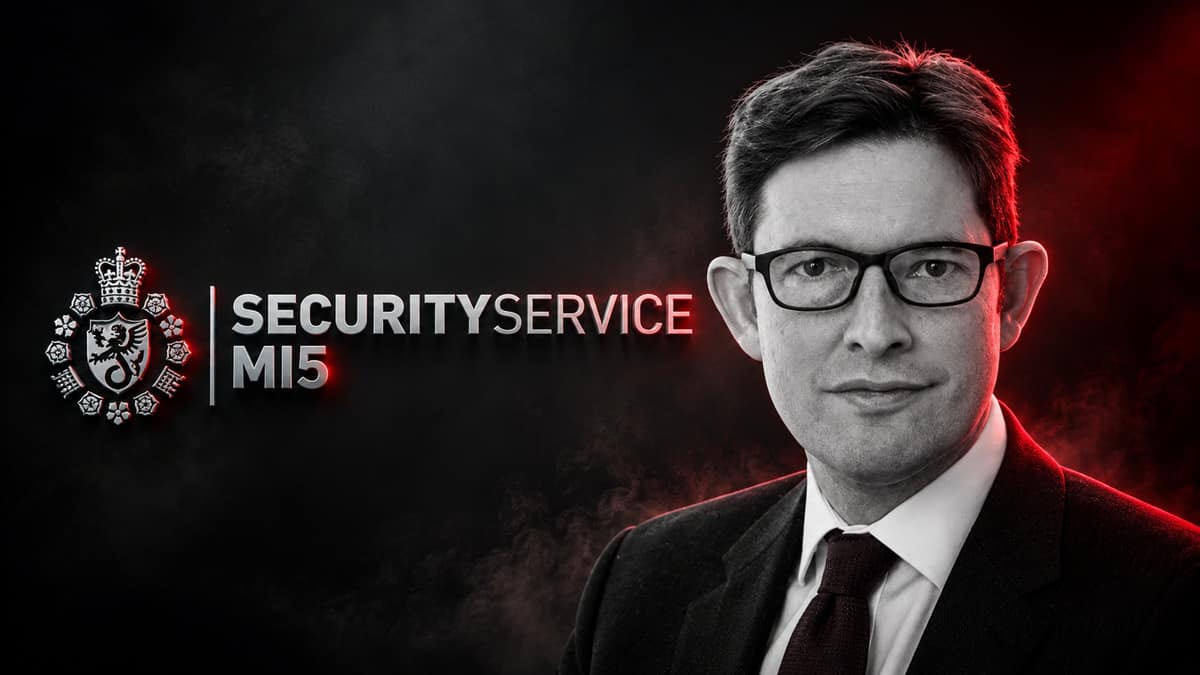
In his annual threat update in London on Tuesday, MI5 Director General Sir Ken McCallum said the country has entered a "new era of national security," highlighting the emerging risks posed by artificial intelligence.
MI5 is the UK's domestic intelligence agency, responsible for protecting national security against threats including terrorism and hostile state activity. While it is somewhat comparable to the FBI in the United States, it has no arrest powers and works alongside law enforcement agencies.
During the speech, McCallum outlined three interconnected elements of national resilience as part of MI5's focus on protecting the UK against emerging threats.
On systemic resilience, McCallum highlighted the need to protect critical infrastructure, assets, and services, including financial systems, energy grids, supply chains, and manufacturing bases. On societal resilience, he warned that hostile actors exploit social divisions, sometimes amplified by polarizing algorithms, to undermine community cohesion and democratic institutions. The third element, technological resilience, focuses heavily on AI.
"Just as the benefits of AI are real, so are the national security risks," McCallum said. "AI is already supercharging the cybersecurity contest between attackers and defenders."
McCallum cautioned that AI can produce propaganda and radicalising material tailored to the individual, adding that MI5 has caught terrorists seeking to exploit AI to improve their reconnaissance and attack methodologies, including AI-enabled drones.
Though not yet realized, he reserved his strongest warning for AI's potential to "change the stakes on existing or even new bioweapons."
AI Threat Assessment Centre launch
The combined UK intelligence community, MI5, NSA-like GCHQ, and CIA-like MI6, is working closely with the UK's AI Security Institute to take on these risks, McCallum said, stressing the need to stay ahead of threat actors harnessing the technology, especially with AI increasingly accelerating its own development.
McCallum said the agency has helped combat new attack vectors in the past by building new structures to analyze emerging dangers, such as the Joint Terrorism Analysis Centre in the 9/11 era.
On Tuesday, McCallum announced MI5's launch of the AI Threat Assessment Centre, or AITAC, drawing on expertise from the AI Security Institute, National Crime Agency, and National Cyber Security Centre to specifically assess emerging threats from the technology and inform national security decisions.
"As government seeks both to seize the huge opportunities of AI and manage the risks thrown up by its misuse, it's vital that we see these emerging domains clearly, enabling consequential choices to be made at pace," he said.
Beyond the misuse of AI by adversaries, McCallum also warned against the risks posed by the technology itself, particularly when it comes to human alignment.
"Put at its simplest, human history has given us no experience of facing an actor which is smarter than we are, [and] is capable of out-thinking us," he said. "This is genuinely novel, and deserves the serious attention it is getting, including in MI5."