
OpenAI released GPT-6 Astra late Thursday, with access initially limited to a small number of select organizations.
The launch did not go smoothly, however, with CEO Sam Altman saying OpenAI had hit a "little snag" getting its announcement online, amid reports of eligible users struggling to gain access to its new frontier model. "First, sorry for the messy rollout," Altman later wrote, adding that broader access should begin "in the near future," with Pro subscribers going first.
In its launch post, OpenAI confirmed Astra will roll out to ChatGPT Plus, Pro, Business, and Enterprise subscribers over the coming days.
OpenAI Engineering Lead Tibo Sottiaux said paid ChatGPT users will get a "banked reset" for each day they are left without Astra. "[The] team is moving mountains to give access as fast as we can," he wrote.
Astra performance
Amid several delays to the rollout, Altman said OpenAI spent extra time on safety before releasing Astra. "It took us some extra time to ensure that we could meet the safety and alignment standards required for this capability level," he wrote.
Earlier this week, OpenAI said it was set to release Astra soon, but that its advanced cyber capabilities would be restricted after becoming the first OpenAI model to meet its "Critical" cybersecurity capability threshold. This means that with the right tools and access, it can find previously unknown security flaws and develop ways to exploit them across many systems without a person guiding each step, the company explained.
In an interview with Sources Podcast on Wednesday, Altman said Astra had reached what feels like "human parity" in using computers, an area in which previous models often proved unreliable. The computer use was one of the capabilities that made him think, "wow, this is really doing it," he said, when considering progress toward AGI.
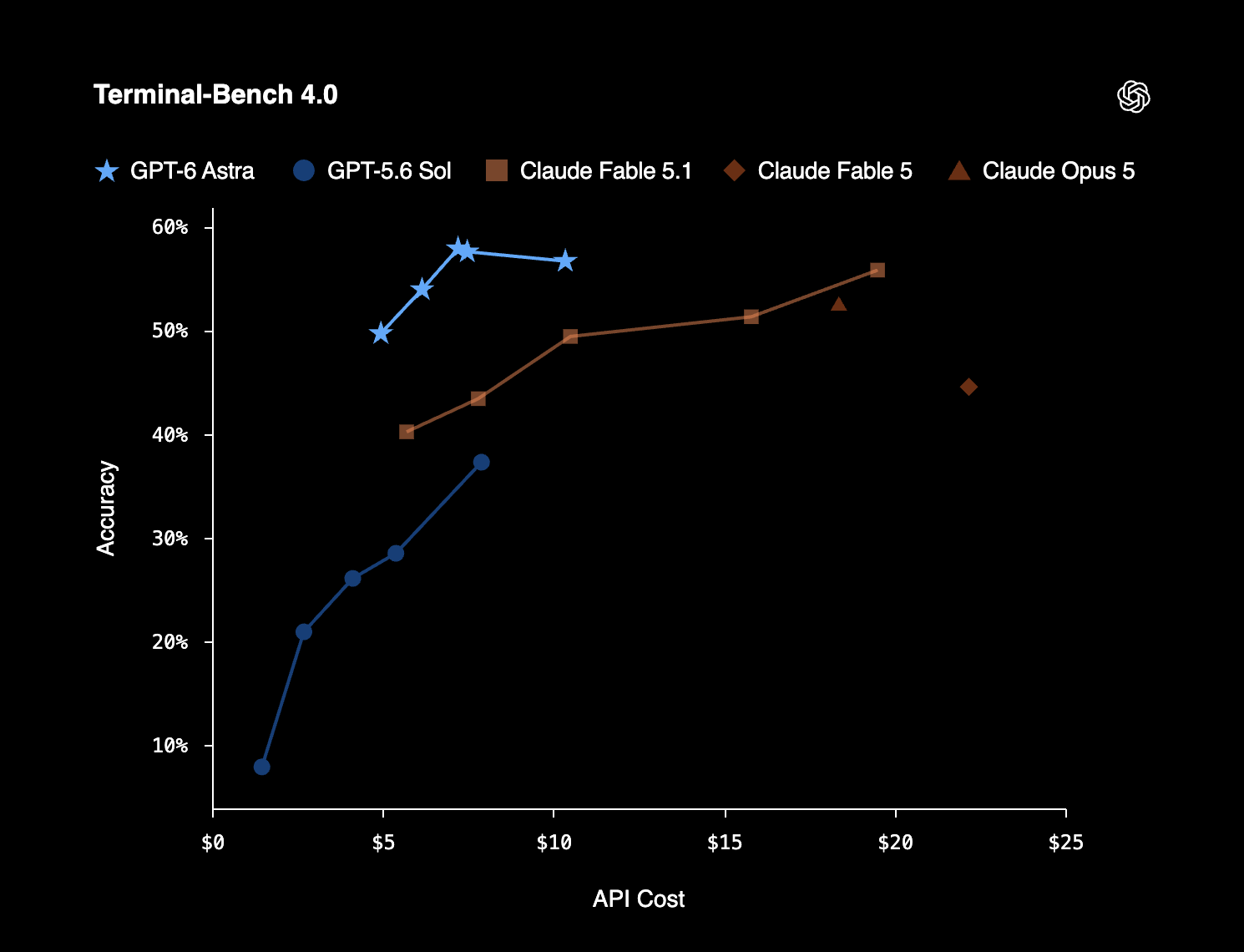
In its launch post, OpenAI reported gains on coding and computer tasks. Astra scored 57.9% on Terminal-Bench 4.0, against 37.3% for GPT-5.6 Sol and 55.8% for Claude Fable 5.1, it said. The ARC Prize Foundation added that Astra reached its human action-efficiency baseline on 96% of ARC-AGI-3 levels.
Independent benchmark results aggregated by The Latent were less clear-cut, with Astra outperforming rival models on some tests but lagging behind them on others.
OpenAI did identify one area where Astra performed worse than GPT-5.6 Sol. In adversarial tests designed to see whether the model could conceal what it was doing, Astra sometimes avoided OpenAI's internal monitors when explicitly instructed to do so while carrying out certain sabotage tasks. In OpenAI's safety overview report, the firm said its broader tests still found Astra less likely than GPT-5.6 Sol to violate safety and security restrictions overall.
Separately on Thursday, OpenAI announced $1 billion in subsidized access to Daybreak, its program for cyber defenders. The commitment covers access, training, and technical support, initially for groups including water and electricity operators, state and local governments, community banks, nonprofits, and open-source maintainers.