
The AI industry needs to generate $6 trillion in annual revenue by 2031 to justify the unprecedented speed, scale, and cost of the infrastructure buildout taking place, according to a new report from Bain & Company.
The global management consulting firm said Tuesday that productivity gains from existing enterprise and consumer applications won't be enough and entirely new markets need to emerge to close the funding gap. "The winners will be those that create breakthrough AI applications that transform industries and expand the global economy," it said.
The costs are accelerating, with capital expenditure from hyperscalers Microsoft, Google, Amazon, Meta, and Oracle potentially reaching $780 billion in 2026, according to Bain, nearly five times the amount just three years ago.
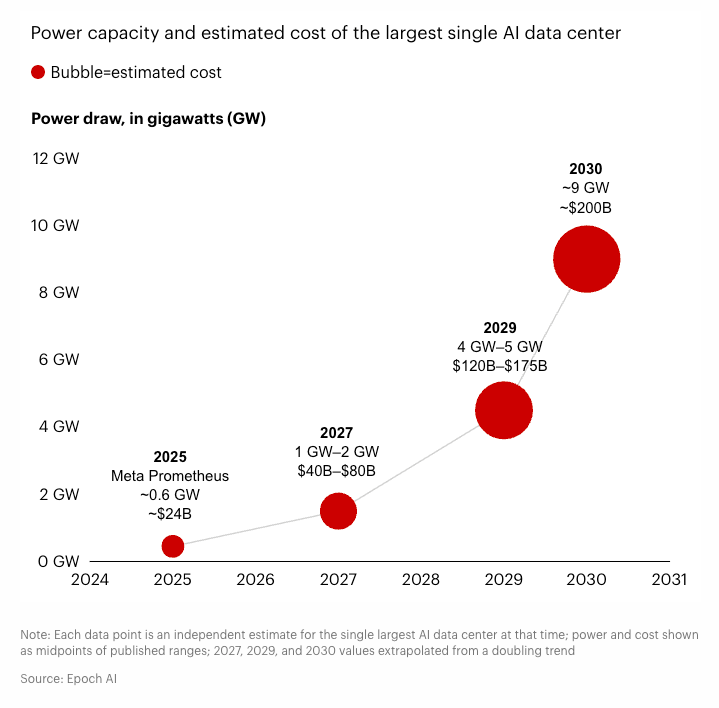
Meanwhile, AI data centers are approaching 1 GW of power capacity, with many expected to approach 2 GW facilities next year and 9 GW campuses by the end of the decade, Bain said.
Spending to reach $1.5 trillion by 2031
The level of spending is projected to reach $1.5 trillion by 2031, per Bain, including data center infrastructure and compute capacity, plus upgrades to installed GPUs, memory, and networking equipment.
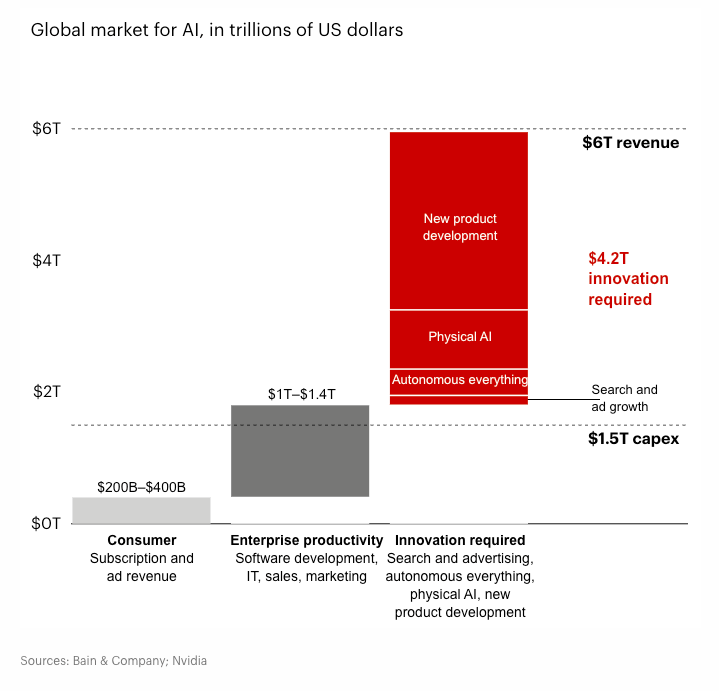
Based on known trends among cloud providers and assuming capital expenditures amount to approximately 25% of industry revenue, sustaining that level of investment would require the AI market to approach $6 trillion annually, Bain said.
The consultants suggested that consumer AI products could generate an estimated $200 billion to $400 billion of that by 2031, and enterprise adoption could add another $1 trillion to $1.4 trillion.
However, that $1.8 trillion upper value still leaves a $4.2 trillion shortfall to reach the $6 trillion level needed to fund the buildout in Bain's estimation.
"That revenue must come from new sources of economic value," it said.
What are the potential sources of value?
"Dramatic innovation" is required to fund the gap within the timeframe, in Bain's view, presenting search and advertising, "autonomous everything," physical AI, and new product development as four areas that could help.
The management consulting firm argued that search and advertising could bring in $100 billion to $200 billion through the integration of ads into frontier models' chatbot products. "Autonomous everything," which Bain describes as using AI to autonomously operate automobiles, trucks, drones, and other industrial automation initiatives, could generate $400 billion. Physical AI, including humanoid robots, represents another $900 billion opportunity, according to the firm, while new product development, including AI-driven drug discovery and mental health support, could help close the remaining gap.
"The industry needs a wave of application innovation comparable with what mobile and cloud unlocked, not just productivity gains on existing workflows," Bain wrote. "The infrastructure is being built ahead of the demand curve, and funding it sustainably will require adding approximately 1% to the annual global GDP growth rate. The question is whether the applications arrive in time to pay for it."