Meta reportedly claims in its Internal Revenue Service filings that its AI data centers are a big experiment that could fail, allowing it to tap into tax credits.
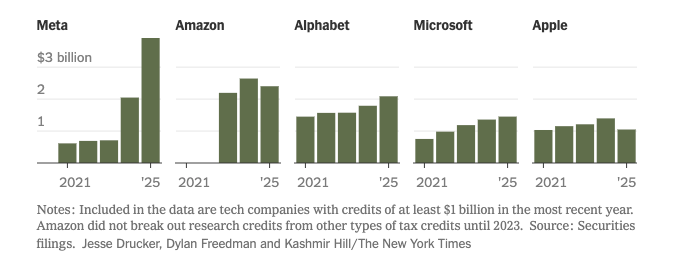
The strategy has been lucrative, The New York Times reported on Wednesday, citing four people with knowledge of the company's operations. The research tax credit helped Meta save $2 billion in 2024 and $3.9 billion in 2025, up from $700 million in 2023 before it began its data center strategy, an NYT review of securities filings found.
Meta executives kept the tax strategy close to the vest, two people with knowledge of the discussions told the NYT. As the IRS may challenge its interpretation, the company acknowledged the risk in an "unrecognized tax benefits" securities disclosure, according to the report. This is effectively the gap between what Meta paid the IRS and what it might owe if challenged by the tax authority.
Meta's use of the tax break for data centers has not been previously reported.
How it works
Meta reportedly classifies its data centers as "pilot models" for tax purposes, utilizing a tax credit created in the 1980s to encourage innovation. Companies can get rebates for supplies, but only if they are being tested in an experimental effort, not standard business operations, the NYT said. Meta is also claiming the cost of AI computer chips, including those from Nvidia, under the strategy, according to the report.
The move has reportedly caused some unease within Meta's finance department. Tech companies often benefit from the scheme, but normally for salaries paid to researchers and engineers carrying out innovation, not for basic supplies, which have been challenged in the past.
Meta is already in one dispute with the IRS for using the tax break to subsidize CEO Mark Zuckerberg's multibillion-dollar compensation, the report noted. Meta claimed that $4.1 billion of stock options exercised by Zuckerberg in 2013 counted as a research expense as he helped invent new software. The IRS is trying to recover $355 million in tax savings, according to court filings.
Categorizing its data centers as experimental is "kind of wild and out there," Andre Shevchuck, a partner at advisory firm BPM who specializes in the research and experimentation tax credit, told the NYT.
"Meta is one of the largest investors in research and development in the United States," Meta spokesperson Andy Stone told the NYT. "Over the last five years, Meta invested $200 billion in R&D - $57 billion in the last year alone, advancing frontier research, building new technology and supporting American jobs. Like other companies that invest at this scale, we use the tax incentives Congress established decades ago to encourage this type of domestic investment."
The Latent reached out to Meta for comment.